This is the last of the blogs to be made for this Game Design Class! But to be honest, it won't be the very last, keep tuned for other Game Design Elements and other things later!
For this game design project, what we had to do, was to make a board game, a poster, a trailer, and a write up. With this, we saw difficulties because of the game we were making. We didn't have enough time to make everything, so what we did is that we split up the work, having multiple time checks to ensure that we would have everything done.
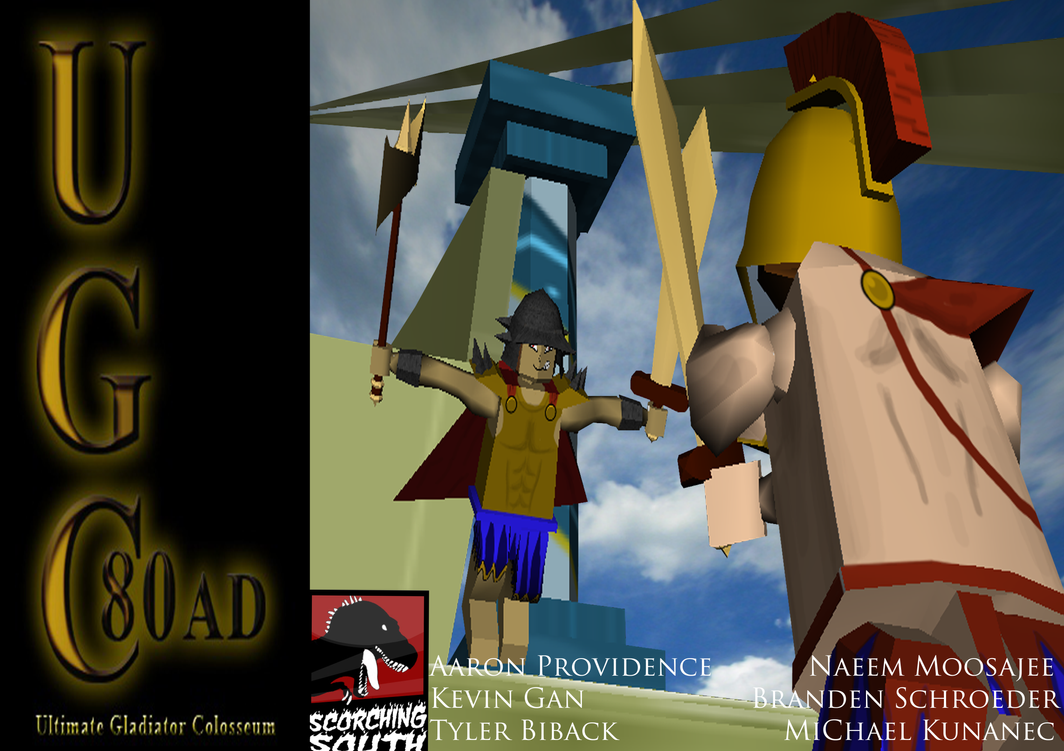
When assigning the work, we looked at each persons individual strengths, and availability for the task. I was assigned the poster. Through some modelling work in maya, and positioning of the camera, i was able to make this picture for our game, Ultimate Gladiator Colosseum: 80 AD
The written works were to be done by Kevin, Naeem and Branden. Tyler made an amazing trailer for the game.
Thanks for reading my blog post! sorry for the shortness, but more will be added later when it can!
Kazekumaru -- Peacing Out!!
Wednesday, 11 April 2012
Sunday, 1 April 2012
Game Design and Production Blog 11 - Game Design Class and What goes on during it (INFR 2330)
Game Design Class and What
goes on during it
This class to me at
the beginning of the semester, seemed like a joke, seeing the professor almost
as young as us, walking in with his bowtie, and his hilarity. But as time went
on, I began to see the reason why everything was done within the class up to
now.
The way that he
teaches the classes, he throws a ball around to people wanting to answer. That
is for interaction and the want to have your voice heard, and having your
opinion and insight matter. Although
I've only gotten the ball once or twice within the entire semester, I had a lot
of insight and understand the reason for it.
The classes are
interesting. Once, our professor put a live twitter feed on a projector screen.
What was funny, to me at least, was with anything he said that was funny, could
be turned into a joke, or made no sense, I would copy it, tag it with "#NackeQuotes"
and post it on twitter, thinking it was hilarious.
Although it was
hilarious, it also kept me listening intently to what was being said within the
class… though I was pretty sure that once he figured out it was me doing
#NackeQuotes, he would hate me.
One big strain with
this class are these blogs that we have to continuously make. Although it is
fun joining up with friends to make a game, it is a hassle because of
everything that we have to do for school. i.e. the game, and other
assignments…..DANGIT I JUST LOST THE GAME T_T…( If you know what "the
game" is, I'm sorry, else, don’t worry. Trust me." (you know I'm in
gamedev when I use "else" instead of "otherwise"…))
But in all honesty,
this class is fun, interactive, and we have a fun teacher ! (when we all stop
trolling or being loud) He is interactive, and he gave us LoL banners for
getting good grades in his class?! #ProfessorGoingToGDCFTW.
Blogs, what I think
of, are a ways to express ourselves, and I believe that I am expressing myself
freely here. I hope to see further instalments and fun within our future
classes until school is over.
Thanks for reading
my post!
Kazekumaru --
Peacing Out!
Sunday, 25 March 2012
Game Design and Production Homework 7 - Hero Character
Character Interview
What is your
name?
My name is Amahté. It means “To have
power over”.
Gender?
I am a male.
Race?
I am Egyptian.
Religion?
I believe in the great Deities.
Age?
Currently, I am 19 years of age.
Where were
you born?
I was born near the Nile River to my
late mother. My mother and my father were hiding near the Nile river, because
at the time, my mother was pregnant. The baby was to be born within a quiet
town, until it was thrown over and destroyed by the pharaoh. From then, my parents
had hid themselves, conceiving me, and for the next five years, protected me,
hoping that they could escape peacefully. However, that state of peace was
interrupted by the pharaoh.
What about your parents—where are they, and
are they alive?
My parents are no longer alive. They
died when I was at the age of 5. When I was 5, my parents were taken into
slavery, by the current pharaoh, but I did not know for when they died after
that because they left me behind to stay safe, and fend for myself. However,
when I was taken into slavery, I had asked the slaves around me about my
parents, but they said they died as of two years ago for trying to escape.
When you were growing up, did you struggle,
and if so, in what way?
From when my parents died at the age
of 5, I went on struggling to live, and not be captured for slavery. I was able
to remain safe from slavery and toil until the age of 7 when I was captured.
What year is
it now?
The year right now is 3172 BC. The
current pharaoh has us being slaves and building more and more for him. We are
to build another pyramid under his name.
How would
someone stereotype you at a glance?
Someone would naturally stereotype me
as a slave within hold of the current pharaoh. I am one of the darker slaves,
because I am outside, usually in the sun, doing work, or trying to take
resources for the escape and freedom of my people.
Do you have
a romantic partner? If so, whom?
As of now, I currently have no
romantic partner. I have no time for such a relationship, I must tend to my
people. Romantic partners during this time of slavery would be painful, for my
one concern is that if I was to love someone specifically, if they were caught,
I would not be able to be happy until they are free and also with my people and
comrades.
Who is your
best friend and what is he/she/it like?
My best friends name is Ahmirad. He
is very loyal, and wants to help me free my people. We have known each other
for 10 years, and we are inseparable.
How would your friend describe you?
Ahmirad would probably describe me as
a silly individual, but brave and hardworking with a heart that goes to
everyone.
What is your
economic situation? What have you done for work?
The economic situation is terrible
under the current pharaoh… I have no job. I am a slave to the pharaoh and am
only able certain meals.
Would you
steal?
If to help my people, then yes I
would steal. So be it.
How do you
feel about lying?
When it comes to lying, I will lie to
anyone above me under the rule of the pharaoh or against me freeing the slaves,
otherwise, I do not lie. I lie to my enemies. Not my comrades. I lie to
protect, not to gain.
Can you be
trusted by your friends?
I would hope that I am. I hope only
for their well-being and not their downfall.
Do you have
any other vices?
At the moment, I have no other vices,
than freeing the slaves, and keeping everyone safe.
What makes
you happy? What makes you sad?
What makes me happy is seeing my
comrades in the notion of happiness. If my comrades and people are sad, I share
their feelings in sadness.
What is the
one secret that no one must know about you?
I have no secrets, for I must be true
to all of my comrades.
Are you
afraid to die?
I am scared to die, but if for my
comrades or people, I will risk my life at any time.
Do you have
any phobias?
I try to not be afraid of anything, I
rather confront my fears and defeat them. The one thing in life that I cannot
defeat is death. With this, I could say that my one phobia is death.
Are you
quick tempered or patient?
I am patient as far as I may be
knowledgeable about myself. Ahmirad may say otherwise.
Biography
Description
Name: Amahté
Birthplace:
Nile River, Egypt
Current
Location: Slavery Location near Pyramids
Age:
19
Religion:
Great Deities
Race:
Egyptian
Spoken
Languages: English
Weight:
140 lbs.
Height:
5”8
Eye
colour: Brown
Hair
Color: Black
Overview
Amahté
is an Egyptian man. He lives in a slavery camp near the pyramids in Egypt.
Although he was never a bad person or even child, he was taken into slavery,
and forced to work until he dies. At the age of 9, he met his best friend
Ahmirad, which would eventually prove to be a person who is crucial to the plan
that he is making in order to free all of his comrades and slaves to create a
peaceful life. After the age of 10, he had started plotting an escape for all
the slaves. Through sly tactics and help from his best friend Ahmirad, his collection
of items for the escape has proceeded smoothly and safely. It has been 9 years,
and Amahté feels that his chance to escape has finally arrived. Amahté could be
the hero of the slaves and his people, if the plan succeeds so, then he will
be, else he may die in the process.
Strengths
Amahté
is an admirable person. He is very patient and is very willing to plan well
when it comes to certain outcomes. He is silly with his friend Ahmirad and is
able to be himself naturally around him. When it comes to his comrades and his
people, he is very caring and would never betray anyone. These traits lead him
to be able to make comrades and close friends very quickly and also enable
people to believe in him.
Weakness
Although very patient and planning, he can be quite obvious
with some movements, so with the help of Ahmirad, he is able to conceal
movement, and make it more silent in order for the guards of the pharaoh, and
the pharaoh himself. The obvious movement flaw is the only thing that may lead
to his downfall. Because of this, it shows that he needs his friend Ahmirad in
order to show his perfection to his plans and other efforts.
Personal History
and Story Arc
Amahte was born near the Nile River in
Egypt. His parents were escaping slavery and trying to hide around the time
that he was born. The place in which the parents were escaping to and hiding,
was a very poor town. Though saddening, they never lost hope in their child
Amahte. At the age of five, the parents of Amahte were taken, and everything
was in chaos, though Amahte was aware of his parents actions, even at such a
young age. From his age of five, Amahte scavenged and survived for two years on
his own, fending for himself, and overcoming his fears, up until the day he was
captured and put into slavery.
Soon after becoming a slave, Amahte was
distraught, but his feelings of freedom, love, and peace never escaped him. Two
years passed, and he met his best friend Ahmirad. A year after this, he had
planned to make an escape for the slaves. Such a valiant idea for such a young
man, obviously the other slaves said he was a fool, but some believed in him
and developed an admiration, for without it, some of their lives could not
continue because of the strife.
As years pass, Amahte, with some help from
Ahmirad continuously planned and made efforts to enable the escape of the
slaves. Although very dangerous, they never lost hope. They continued making
escape routes secretly, and taking weapons in order to defend themselves. These
actions continued for 10 years..
Amahte is now 19, and plans to make the
escape for all of the slaves. He is waiting for a few months for the
escape...and his plan may be taken to fruition…
Defining Moment 1:
While carrying a plan out, one person could make a plan, but
it takes a team to be able to accomplish it properly, or bring it to fruition.
What Amahté did, is that he
assembled a great force of strong willed, and loyal people into a group, made
plans, and was able to get them all including himself to work, and make escape
routes in which would make escaping easier. He then was able to free the
slaves, in which did create a battle with the guards and the pharaoh. However,
because of the people that he was able to assemble, he was able to free
everyone properly and create peace, even under the current pharaoh.
Defining Moment 2:
Soon after
being able to free the slaves, the people felt to elect Amahté to be the next pharaoh. With
this, they all felt that the people would be safe from harm, considering his
heart, resolve, and the want for freedom and peace that he had held onto all of
his life. Ahmirad would be appointed to a high ranked guard of the pharaoh Amahté,
and the other guards would be the people from the group that Amahté had
initially made to help free all the slaves.
Sunday, 18 March 2012
Game Design and Production Blog 10 - Hopscotch Game (INFR 2330)
Snowboard Cross: Hopscotch
Edition
Hello! Welcome to my
blog!
Today, I will be
talking about a hopscotch assignment given to us for the Game Design and
Production class.
When in class, our
teacher asked us to get into groups and told us to make a brief half-an-hour
study on the game of hopscotch. We were able to come up with a couple of
different aspects, and rules for the game of hopscotch.
Here is what we had
found:
Creating the
Hopscotch Prototype:
-------------------------------------------------------
Different Skills
involved in Hopscotch:
- Jump, Balance,
Toss the rock into in the square (aim), patience/focus.
Luck Elements
Involved:
- Rock lands and
rolls (unlucky)
- weather conditions
(push you or resist you with wind)
Apparently, we were
supposed to use all aspects in which we found, and implement them into a game.
As I continued reading into the aspects we found, it kept pointing me back to
the game "Snowboard Cross" which was mine and Tyler Bibacks first game
for this class.
When I went through
the aspects, this is what I linked all the aspects to:
Different Skills
involved in Hopscotch:
- Jump(Jumps in
snowboarding)
- Toss the rock into
the square(aim) -> toss an object(given) within a square on another
board...whatever you land on, is what you move
- patience/focus
(landing jumps and acing turns)
Luck Elements
Involved:
- Rock lands and
rolls(unlucky) -> when you throw the object onto the space(grid) with a
certain number that you want, and it rolls one extra spot, in which gives you
the number you did not want
- Certain cards
enable you to go faster or hold you back...its the luck of the draw (certain
spaces on the game board)
With this, we made a
Skype call to the entire group, and the majority agreed on these mechanics, so
with this, we worked it into the old rules of the game.
Here is the modified
ruleset to compensate for Hopscotch:
Included: 32 Icy Cards, Freestyle Boardcross Race-To-Survival Boardgame(Remix), 4 game
pieces, 1 rock.
Number of Players: 4
What is the game?
These judges are
crazy! It seems you and your 3 friends have been thrown into a snowboard cross
race – in the white slopes Boarder’s Hell. As soon as the last boarder is out
of the gates, the peak of the mountain will be blown up with TNT causing an
avalanche to come crumbling down behind you! If the snow bunnies are on your
side, you will be the first to cross the finish line and guarantee your
survival! Keep playing until 2nd and
3rd place has crossed the finish
line. If you do not cross the finish line by the time the speed deck is
reshuffled three times, the avalanche will kill you! As an added penalty, you
may be dealt time penalties (and forced back uphill) or if you happen to fall 3
times you are automatically disqualified from the race and you pack it up and
go home.
Who gets the head start out
of the gates?
To move in this game, you throw the given
object onto the grid which is filled with numbers. Whoever lands on the highest
number, is able to get out of the gates first.
Turns
To start your turn,
roll a die onto the gridded board. Move the correct number of spaces downhill
as stated on the board. If the deck of Icy cards gets shuffled twice and runs
out, the avalanche has caught up to you and consumes you. You are dead and the
game is over for you. After moving from the original toss of the object onto
the grid, and dealing with icy spots as appropriate, your turn is over. The
player sitting to the right begins their turn next.
Icy Spots
If you land on an Icy Spot, draw an Icy card. If the card tells you to move again and you land on
another Icy Spot:
- Do not draw another Icy card.
- If you land on icy spot on the take-off for a jump, you must throw the rock onto the grid in which is greater than 4 to make sure you will maintain your balance and control when you land. Stay on the ramp until your next turn. (See Jumps)
- If the icy spot is on a quarter-pipe turn, you must throw the object on the grid on a space marked 3 or higher and finish rounding the corner before ending your turn. (See Quarter-Pipe Turns)
Icy Cards
Icy Cards are the
‘make or break’ cards of this game. They may either aid or hurt you. Some Icy
Cards will cause you to move downhill, others make you go back uphill. Some
cards will even cause you to fall landing you another X in your Fall Count.
Good Luck! You will need it.
Jumps
If you land on one
of the icy patches leading to a jump, you have landed on a Focus Spot. Instead
of picking up another Icy card, you must throw the object onto the grid to
determine if you are focused enough to land the jump properly or not. You must
land on a space on the grid labeled 10 or higher. If it is anything lower, you
fall and sprain your ankle which counts as another X towards your Fall Count. .
You do not complete the jump during your current turn; instead you must wait
until your next turn and continue normally.
Quarter-pipe Turns
These turns have
massive walls like Quarter-Pipes allowing boarders to ride the wall and gain
maximum speed on the corners of the course! If you land on the Icy Spot on the
corners, you must throw the object onto the grid on a space marked 3 or higher
and get off the icy corner before you can end your turn. If the throw of the
object doesn’t get you farther than the 3
spaces, your turn ends and you must go back uphill 2 spaces.
We got through this
well and receiving fine marks for the work.
Thanks for reading
my post!
Kazekumaru --
Peacing Out!
Questions to
consider:
- Do you like the changes we made to the game? If not, why?
- Do you know of any other modifications that we could have made to this game so that we could improve? If so, what are they?
Game Design and Production Blog 9 - Farm Game (INFR 2330) (INFR 2330)
Can YOU tell the seasons where
certain type of fruits and vegetables grow?!
Hello! Welcome to my
blog!
Today, I will be
talking about a farming assignment given to us for the Game Design and
Production class.
With this
assignment, we were to make a game in order to teach people when which fruit
and/or vegetables are in season…
When I saw this, I
thought to myself… "HOW?!" it was a really rough start… but after a
while of thinking, I came up with a good thought.
If one was to teach about fruits or vegetables within four seasons, why not make a board with four seasons? So I created a rule-set utilising this idea.
In this game, a
board is divided into four, and there is a deck of cards in which represent the
seeds. Every turn, a player is able to draw a card (draw a seed card) so that
they could be able to plant another fruit, or vegetable.
Here is a rule-set going further into detail about the
game:
What is the game?
You’re a farmer
trying to get the most amount of harvest before ten years end.
Objective
Go around the board
twice, planting, and harvesting. Whoever has the most harvest, wins the game
after going around the board twice.
How to play
The board is divided
into four sections: summer, spring, fall and winter. You start in the spring. In the spring, you
can plant and harvest vegetables, and fruits. This also counts for the summer.
In the fall, you can only harvest mushrooms and hay. In the winter, you cannot
harvest anything, except some special herbs that may grow regardless of season.
Every season has 20
spaces to travel in. In each season, there are a certain amount of dirt spaces.
However, the only proper seasons in which you could plant and harvest foods is
in the spring and summer. In the spring and summer, you can plant any seed in
the dirt spaces. You can only harvest after 5 spaces pass within each season.
If out of a season, the next time you come back to the season in which you had
planted your seeds, your harvest would still be alive for you to harvest.
There are a deck of
seeds. Each turn, everyone draws from the deck of seeds. Each seed has a name
on the card so you know what you are planting, and if you can or not. Each time
a seed is planted, you take a marker so that you know what type of seed it is,
and that you planted it. On the bottom of the marker ( a tile with two sides),
you get your harvest.
You are only able to
plant and harvest during your turn.
Before each season,
there is an event space of which everyone passes over. There are four decks for
these event spaces. The event spaces can be either good or bad. For example, if
you land on a space before winter, a card that you could draw could be like “oh
no! Winter has come too fast, all of your previous crops have shrivelled up,
and died.”
An example of a good
card could be, if before summer, “all crops that you planted in the spring have
grown because of the sun! you may harvest them all.”
_______________
With all of this, I
thought I was done, but as I thought about it after I had submitted it, I
thought of more things to add to the game.
Thanks for reading
my post!
Kazekumaru --
Peacing Out!
Questions to
consider:
- If you like the rule-set, would you like to see it made into an actual game?
- What other changes do you think could be made to the game from just reading this?
Game Design and Production Blog 8 - Spider Solitaire: Competitive Version (INFR 2330)
Spider Solitaire:
Competitive Remix
Hello! Welcome to my
blog!
Today, I will be
talking about the solitaire assignment given to us for the Game Design and
Production class.
In our previous
class before our professors had went to GDC (Game Developer Conference), we
were assigned a few different pieces of homework. One of these things were to
make a competitive solitaire game. Although on the internet, other students had
found actual competitive versions of solitaire, I wanted to make a new one.
With this, I had to research for a game in which I enjoyed when it comes to
solitaire. The main game of solitaire that I had enjoyed since childhood, was
spider solitaire.
Spider solitaire was
a game in which I would play repeatedly because of the look and different
gameplay than normal solitaire. I had later introduced this game to my
grandmother, and then she got hooked to the game faster than I initially did.
Here are the normal rules for Spider Solitaire:
What is the game?
Spider solitaire uses
two decks of cards. You have 10 tableau piles. 54 cards are dealt to these
piles (6 cards are dealt to first four piles and 5 cards to the remaining
ones). Top card of each pile is face up.
Objective
The objective of the
game is to build 8 sequences within each suit downward (in order of King,
Queen, Jack, 10, 9, 8, 7, 6, 5, 4, 3, 2, Ace). Whoever gets 5 sequences wins
(competitive addition to the original game.)
How to play
Top cards of tableau
piles are available to play. You can build tableau piles down regardless of
suit, ending at Ace. You cannot build a King on an Ace. One card at a time can
be moved from pile to pile. Groups of cards in sequence down by following suit
may be moved as a unit.
When any of tableaus
are empty you are able to fill space with any card or group of cards.
When you have made
all the available plays on the board, click on the stock pile to deal one card
on each tableau pile. All gaps (empty spaces) in the tableau have to be filled
before the deal.
Now, here is the competitive remix of which I added
onto the initial game:
Competitive Remix
In order to play this
game with two people, there can be turns. Roll a die in order to see who goes
first. Whoever gets the higher number goes first.
In order to win the
game, follow normal rules. Whoever has more sequences in suit by the end wins
(First to 5 wins). In order to interrupt your opponent, you can roll a die ONCE
during each of their turns to either aid you, or place your opponent in the negative.
You must roll a 6. If you roll a 6, you can take a card in which they would
need to put a card down (ex. They want to put down their final ace, and are
going to put it onto a 2.), and move the card onto another pile, so that they
have to take an extra turn, putting that card back.
That's my blog for
this week! I hope you guys enjoyed it!
Thanks for reading
my post!
Kazekumaru --
Peacing Out!
Questions to
consider:
- If you find a problem with my rules, what is it? Leave a comment!
- Would you like any further discussion as to how I thought of any remix of a game? or how my mind works when I think of it?
Sunday, 26 February 2012
Game Design and Production Blog 7 - Macbeth Board Game: MacMafia (INFR 2330)
Macbeth Board Game: MacMafia
Hello! Welcome to my
blog!
Today, I will be
talking about the recent assignment given to us for the Game Design and
Production class.
Our teacher
Professor Nacke, had given us a Shakespearean game to make… JD, Tyler and I had met up with no clue
whatsoever to do with this. We brain stormed ideas, but for a while, we didn’t
know what we could do for the game, until we came up with a random idea. We all
enjoyed playing a "mafia" game in which killers, doctors, detectives
and civilians are chosen, and you have to eliminate the killers (the mafia). So
why not try and incorporate that within this game? That is how we came up with
MacMafia.
Now were for the
roles, and structure. Mafia, is for a
large group of people, and is likely not to be played with a small group (a
larger group is more fun and keeps the game going longer with more suspense).
First question was,
who is playing? Roles? We obviously took Macbeth, and MacDuff, but then another
role was King Duncan, and also, the Narrator. So then we decided to make the
larger game be for 5-10 people. The full roles in which were there are, Macbeth,
MacDuff, King Duncan, the Narrator, three witches, Lady Macbeth, Lady MacDuff,
and Banquo (given that Macbeth, MacDuff,
King Duncan, and the Narrator must be roles in all games).
Now here came the
question... What was the structure? So next, we made it so that, if four people
are in play, Macbeth, MacDuff, King Duncan, and the Narrator are definite
roles, and if five and up, then the mafia rules are used. With this, we came
into the knowledge that we would need to make two rule-sets.
Here is part of the
mafia rule-set:
How to
play:
Shuffle the cards and deal them out face
down. (***Each player must not reveal cards to anyone but themselves***) The only player that everyone can know is the
narrator, the narrator see’s all.
Step 1 –
Everyone but the narrator closes their eyes. Narrator will then call upon the
killer(s) to open their eyes and point at who they choose to kill. Once
killer(s) decide who the victim is they must close their eyes. Narrator will then call upon the doctors to
open their eyes and decide who they think should be saved; they then proceed to
close their eyes. Narrator then lets the detective(s) open their eyes and
decide who they think the killer is. Once the detective(s) come to decision the
Narrator will either nod to let them know if they are right or not. The
detective(s) then close their eyes.
Step 2 – The
Narrator then calls upon everyone to open their eyes. Without revealing who the
killer is, the Narrator must tell who the victim is. If the victim was not
chosen by the doctors then the player doesn`t die. If the victim was not the
chosen player to be saved by the doctors then that player must reveal their
card. Once dead you do not need to close your eyes when told too, but cannot
give away other players roles.
Step 3 – The
Narrator then opens the floor for discussion to nominate who the killer(s)
is/are. Every player is given an
opportunity to convince who they think the killer is. After this each nominee will get a chance to
do whatever it takes to convince as many people as possible why they’re not the
killer. Once this is over the voting process starts, which every nominee gets
the most votes dies. Keep in mind if you are either Macbeth or King Duncan you
want to try your hardest to stay alive.
***Repeat steps 1 to 3 until either
Macbeth or King Duncan dies***
____________________________________________________________________________________
Here is the rule-set
for 4 people:
How to
play:
Shuffle the cards and deal them out face
down. (***Each player must not reveal cards to anyone but themselves***) The only player that everyone can know is the
narrator, the narrator see’s all.
Step 1 –
Everyone but the narrator closes their eyes. Narrator will then call upon the
killer(s) to open their eyes and point at who they choose to kill. Once
killer(s) decide who the victim is they must close their eyes. The Narrator
then lets the detective(s) open their eyes and decide who they think the killer
is. Once the detective(s) come to decision the Narrator will either nod to let
them know if they are right or not. The detective(s) then close their eyes.
Step 2 – The
Narrator then calls upon everyone to open their eyes. Without revealing who the
killer is, the Narrator must tell who the victim is. Once dead you do not need
to close your eyes when told too, but cannot give away other players roles.
Step 3 – The
Narrator then opens the floor for discussion to nominate who the killer(s)
is/are. Every player is given an
opportunity to convince who they think the killer is. After this each nominee will get a chance to
do whatever it takes to convince as many people as possible why they’re not the
killer. Once this is over the voting process starts, which every nominee gets
the most votes dies. Keep in mind if you are either Macbeth or King Duncan you
want to try your hardest to stay alive.
***Repeat steps 1 to 3 until either
Macbeth or King Duncan dies***
_________________________________________________________________________________
It was really fun to
make this game with my friends, and I am excited to see what challenges our
professor gives us next.
For further
information on MacMafia, see our game or ask!
Thanks for reading
my post!
Kazekumaru --
Peacing Out!
Questions to
consider:
- With what you saw above, what do you think about the game? If you want to see the full rule-set, comment, and or email aaron.p.providence@gmail.com
- Would you like to play the game?
Subscribe to:
Posts (Atom)

